A Europe-wide initiative to become the continent’s first carbon-neutral vanadium producer.

Vanadium is essential for Europe’s green transition and strategic autonomy, and is classified as a critical raw material by the European Commission.
Why is Vanadium Critical to Europe?
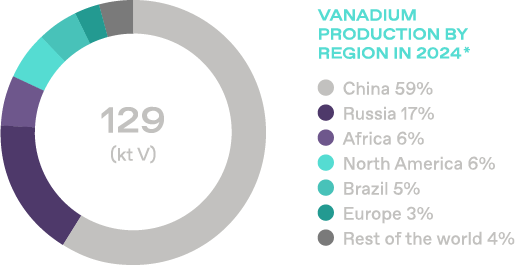
Production by region
The current supply chains are associated with high geopolitical risks. Thus, there is a growing need for sustainable European vanadium production to meet the future demand.
Novana’s plant is estimated to produce about 9,000 tons of V2O5 per year, which corresponds to about 5–6% of the total global production and up to 60% of the vanadium needed in Europe.
* Source: Project Blue as of January 2026 and DERA Deutsche Rohstoffagentur
Vanadium is a metal defined as a critical raw material for almost ten years by the EU.
Europe uses about 8% of the world’s vanadium production but has no production itself. The EU faces vulnerability due to its heavy reliance on vanadium production dominated by BRICS nations, particularly China and Russia.
For Europe to ensure strategic autonomy, lead the green transition and achieve the aims set in the Green Deal, there is a need to look at how materials and minerals crucial to our everyday lives are sourced.
Novana’s production will support the EU target to recycle 25% of critical metals, as provided in the Critical Raw Materials Act (CRMA).
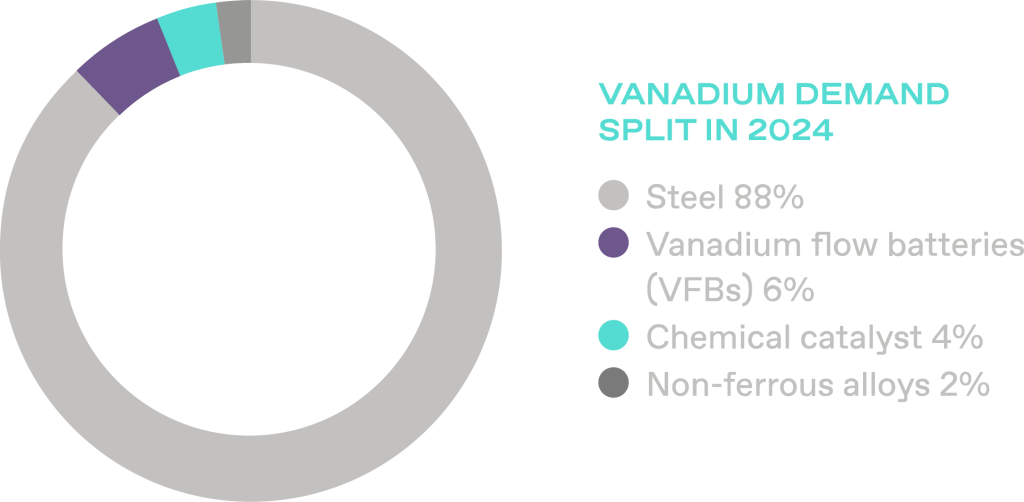
Global demand
The global demand is anchored in steel production, providing a stable industrial base.
The rapid growth of renewable energy is accelerating the demand. The market for vanadium flow batteries is expected to grow at 15% CAGR.
Source: DERA Deutsche Rohstoffagentur
 Vanadium fact sheet
Vanadium is a metal used, among other things, in the manufacture of special steels to increase strength and, increasingly, in the battery and energy industries for grid stability and long-duration energy storage.
As a transition mineral, vanadium enables the creation of two main compounds:
-
Ferrovanadium, making carbon steel stronger and lowering the carbon footprint of buildings
-
Vanadium pentoxide, used in steel applications and flow batteries to enable grid-scale energy storage solutions for the green energy transition
Stabilized slag material (SSM) is produced as a byproduct of the recovery process and can be used as a carbon negative feed material in applications such as the production of cement and/or concrete for building products, land reclamation and soil treatment.
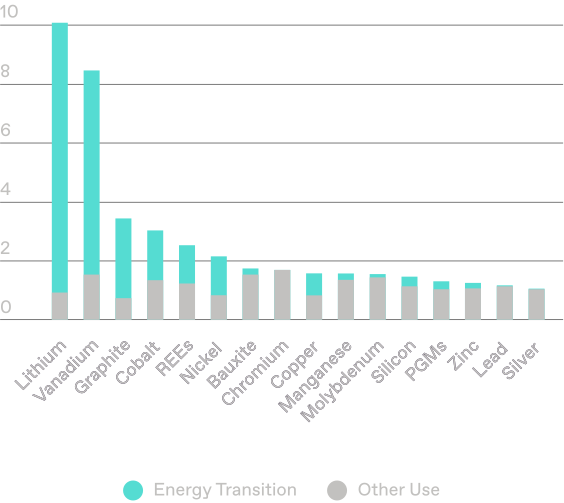
Energy transition to boost Vanadium demand
Vanadium is a crucial material for renewable energy addressing the challenge of intermittency in wind and solar power. These energy sources require large-scale, long-duration storage to maintain a stable and reliable electricity supply. Vanadium flow batteries (VFBs) offer a solution to the issue, providing utility-scale energy storage with unique advantages.
VFBs can store large amounts of energy for extended periods, have a long lifespan of 20+ years without capacity loss, are non-flammable, and use electrolyte that is almost infinitely recyclable.
Vanadium is also used in strengthening steel which supports the construction of renewable energy infrastructure.
According to the International Energy Agency (IEA) World Energy Outlook 2023 and IMF calculations, vanadium demand is projected to increase dramatically by 2050 under the IEA’s net-zero emissions transition scenario. Specifically, vanadium demand is expected to grow more than 8 times compared to 2022 levels.
We will be the world’s first carbon neutral vanadium producer and our innovative ecosystem contributes to the circular economy at large.

How we do it
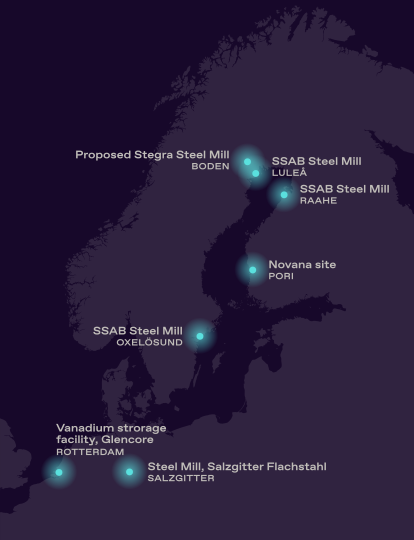
European ecosystem
Circularity is at the core of our entire business model. The creation of a closed-loop system where industrial side-streams are utilised to produce zero carbon vanadium requires a sophisticated ecosystem of partners who share our vision. Our facility, located in Tahkoluoto, Pori, Finland, connects different European actors across the supply chain creating an environmentally sound and geographically efficient ecosystem. We are centrally located to numerous European steel mills, whose industrial side streams are our feedstock, as well as close to potential offtakers of our carbon negative by-product SSM.
Our process
In Novana’s production process, vanadium-containing slag is shipped from EU steel mills to Pori, Finland. In the plant, CO2, sodium carbonate (soda ash), sodium hydroxide, other reagents and water are used to process the slag and recover high-purity V2O5 product from the steel slag. The process creates stabilized slag material (SSM) as a by-product which can be used for green concrete, filler for cement, polymers, and as a substitute for sand. The process consumes large amounts of CO2 and sequesters the carbon into SSM.
Novana facility
-

Location
Tahkoluoto Port, City of Pori, Finland
-

Total investment
MEUR 400
-

Operating cost
Lowest quartile
-

Indicative Construction timeline
Q4 2026 – Q1 2029
-

Throughput
up to 300k tonnes p.a.
-

Planned annual production ~9k tonnes V2O5
Planned annual production ~9k tonnes V2O5*
* About 5–6% of the total global production and up to 60% of the vanadium needed in Europe
Upcoming Project Catalysts and Planned Project Milestones
H2 2026
- Detailed engineering and procurement work commenced
Q4 2026 – Q1 2027
- Stockpile and pond earthworks completed
- Process area civil works begin (earthworks, concrete, steel, cladding)
- Critical packages procurement
H2 2028
- Mechanical completion achieved
- Commissioning begins
Q1 2029
- Pori facility in operation

Why Novana?

Strategic Market Positioning
Vanadium is essential for Vanadium flow batteries (VFBs) and high-strength steel alloys, making it a crucial element for the energy transition. As global demand for renewable energy and EVs grows, Novana is perfectly positioned to meet Europe’s needs in this high-growth market.

Sustainability at the Core
Novana’s “metals without mining” focuses on recycling to reduce environmental impact, positioning it as a leader in sustainable resource management. Its carbon-neutral vanadium and carbon-negative byproduct, Stabilised Slag Material (SSM), verified by Minviro, can be used in cement, land reclamation, and plastics.

Institutional Backing & Strategic Partnerships
With support from European Investment bank (EIB) and EIT RawMaterials, Novana is recognized as a strategic project for Europe. Additionally, its partnership with Glencore ensures secure offtake agreements, providing stability and confidence in its market viability.

Strong Financial and Growth Potential
Novana’s focus on a high-demand market, combined with strategic support and a clear path to scaling operations, provides a strong foundation for long-term financial returns. The project is poised to play a key role in Europe’s green energy transition, creating significant value for investors.
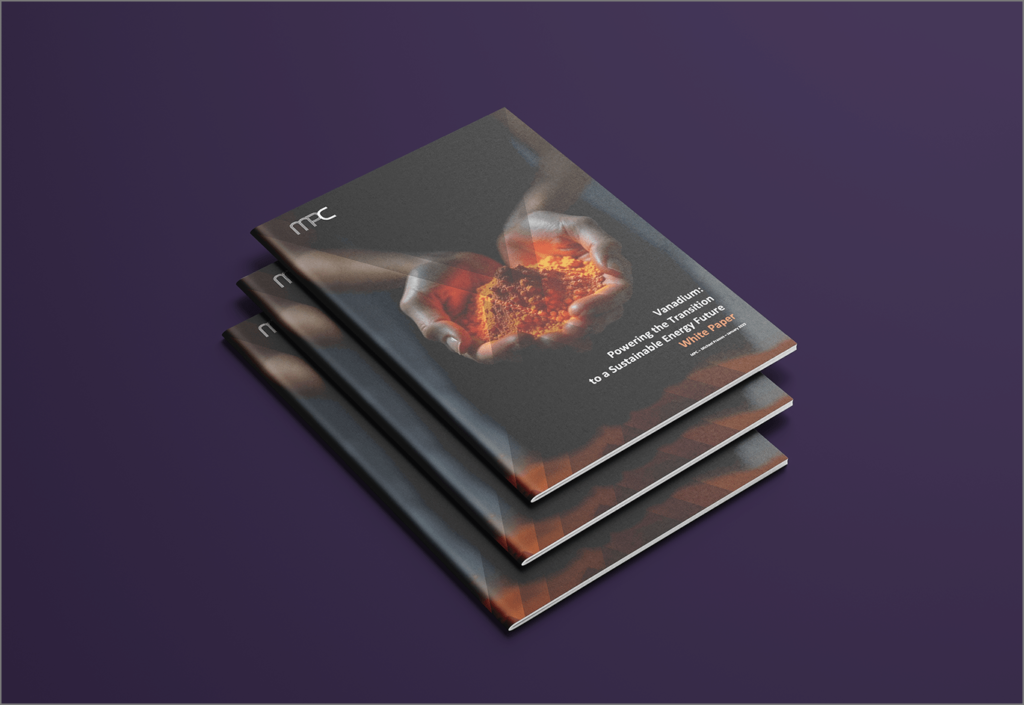
The Ultimate Vanadium Market Report – Free Access to Exclusive Insights
What’s Inside?
- Global Supply Chain Deep Dive – Covers China, Russia, South Africa, Brazil, the U.S., Canada, Europe, Australia, and Kazakhstan.
- Exclusive Market Intelligence – Built on data from MPC, Project Blue, the World Bank, and other industry peers.
- Vanadium’s Strategic Role – Key insights into Vanadium Flow Batteries (VFBs), steel, aerospace, and chemicals.
- Legislation & Policy Impact – Covers EU, U.S., Chinese, Indian, Japanese, and Australian regulations shaping demand.
- Investment & Price Outlook – Market trends, historical prices, and future projections.
- Novana’s Competitive Edge – Assesses how Novana’s carbon-negative, innovative processing technology can secure Europe’s vanadium supply chain.
Download Now and gain a competitive edge in the vanadium market.
Latest news
The team
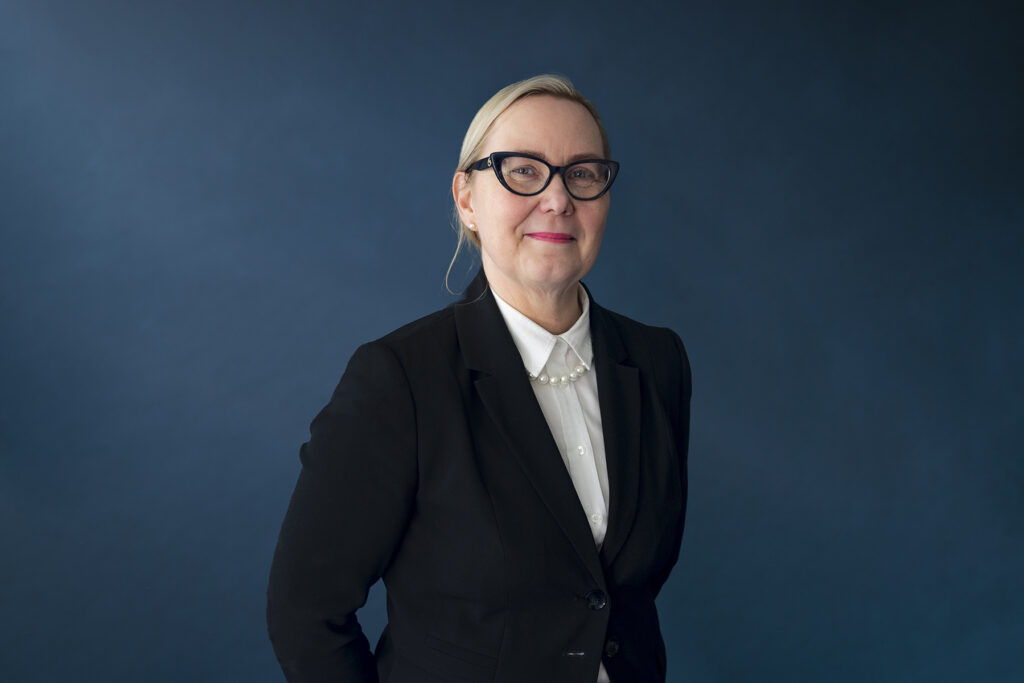
Johanna Lamminen
D.Sc. (Tech.), MBA
- Chief Executive Officer, Novana Oy
- Previously: Chief Executive Officer, Gasum Ltd; Chief Executive Officer and Chief Financial Officer, Danske Bank Finland; Chief Financial Officer, Evli Bank Ltd
- Chair of the Board, Molgas Energy / GreenRiver Holdco S.L.
- Vice Chair of the Board and Chair of the Audit and Risk Committee, Alisa Bank Plc
- Member of the Board and Chair of the Audit and Risk Committee, Mandatum Plc
- Member of the Board and Chair of the Audit and Risk Committee, Auroora Yhtiöt Oyj
- Member of the Board, Stena Recycling Holding AB
- Member of the Board, Finnish Business and Policy Forum (EVA)
- Member of the Board, Research Institute of the Finnish Economy (ETLA)
- Chair of the Board, Savonlinna Opera Festival
- Previous board positions include Sampo Plc, Cargotec Corporation, Evli Plc, Tieto Plc and CellMark AB
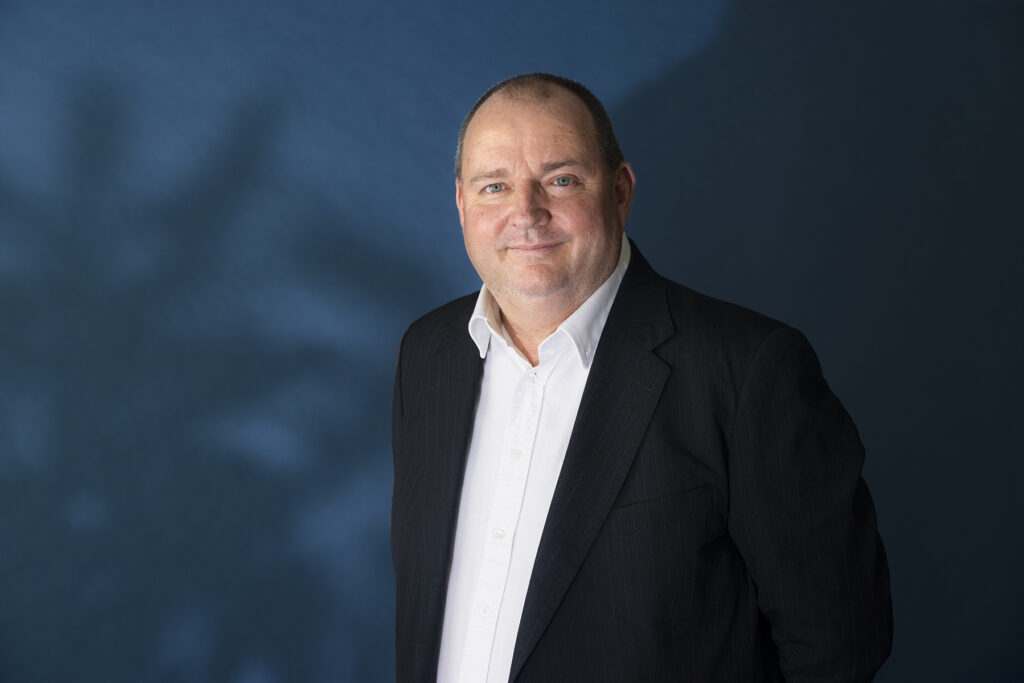
Darren Townsend
COO
- Mining Engineer with 25+ years. development, mining and corporate experience including managing ASX and TSX listed companies
- Head of Vanadium, Neometals, a sustainable battery materials producer
- Key experience: Neometals, Rio Tinto, Sons of Gwalia, Peak Rare Earths, De Grey Mining
Owners


Advisors

suppliers partners and stakeholders